
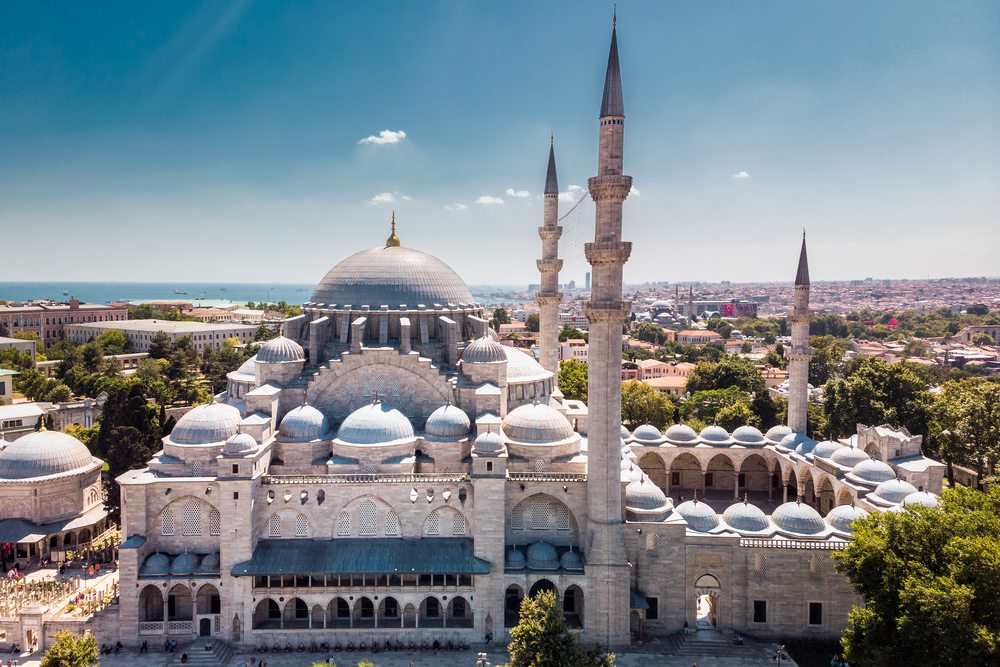
Architect Sinan, often hailed as the greatest architect of the Ottoman Empire, left an indelible mark on Istanbul through his visionary designs that blend functionality, beauty, and innovation. Born in 1489, Sinan served as the chief architect during the reign of three sultans: Suleiman the Magnificent, Selim II, and Murad III. His remarkable body of work transformed the skyline of Istanbul, setting the standard for Islamic architecture and influencing generations of architects long after his era.
Sinan’s masterpieces are characterized by their harmonious proportions, intricate details, and innovative construction techniques. Perhaps his most famous work is the Süleymaniye Mosque, completed in 1557. This grand structure epitomizes the zenith of Ottoman architecture, featuring a magnificent dome that soars 53 meters high, symbolizing the heavens and the power of the state. The mosque complex includes a medrese (religious school), a hospital, a public kitchen, and multiple tombs, reflecting Sinan’s vision of a multifunctional space. The Süleymaniye Mosque not only serves as a place of worship but also as a vibrant community center, fostering a rich cultural life.
The Haseki Hürrem Sultan Bathhouse, another work designed by Mimar Sinan, holds great architectural and historical significance. While embodying all the characteristics of traditional Ottoman bathhouse architecture, it stands out with its intricately crafted marble details and striking mosaics. The bath was originally built to serve both women and men, but over time it has become a special space for women. Today, after restoration, the Haseki Hürrem Sultan Bathhouse continues to operate right next to the Hagia Sophia Mosque, maintaining its importance as a major attraction for both domestic and international tourists, as well as preserving its value as part of the social and cultural life of the Ottoman period.
In Istanbul, Sinan’s architectural contributions extend beyond these central landmarks. The Rüstem Pasha Mosque, completed in 1561, is a hidden gem nestled in the bustling streets of Eminönü. Renowned for its stunning İznik tiles, the mosque features a beautifully designed interior that encapsulates the essence of Sinan’s style—delicately ornate, yet thoughtfully proportioned. The Rüstem Pasha Mosque serves as a testament to Sinan’s ability to create tranquil spaces within the urban fabric of Istanbul.
Sinan’s versatility is evident in the Kılıç Ali Paşa Mosque, built between 1580 and 1587. This mosque showcases Sinan’s ability to adapt his designs to different contexts and client desires. The mosque features an impressive dome and a complex of surrounding structures, including a medrese and a public fountain, further exemplifying his holistic approach to architectural design and urban planning.
Sinan’s architectural philosophy emphasized light, space, and community. His creations harmonized with their surroundings, employing innovative techniques such as the use of semi-domes, which helped distribute weight and create expansive interiors. His genius lay not only in the aesthetics of his structures but also in their functionality, as many of his designs included practical facilities that served the needs of the community.
In summary, Architect Sinan remains a towering figure in the history of Ottoman architecture and urban development. His masterpieces in Istanbul, such as the Süleymaniye and Rüstem Pasha Mosques, reflect a profound understanding of structural engineering and an artistic vision that continues to inspire admiration. Sinan’s legacy is one of beauty and innovation, setting a high standard for architectural excellence that reverberates through history, ensuring that his contributions to the architectural landscape of Istanbul will be cherished for generations to come.