
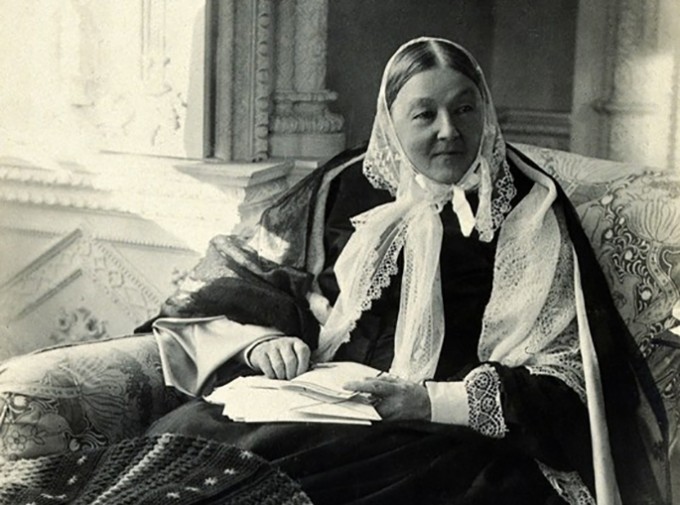
Florence Nightingale, a nurse of English origin, was born in Florence in 1820 as a child of a wealthy family. She spent half of the year in London with her family and traveled to major cities in Europe for the other half. Instead of living a comfortable and trouble-free life thanks to her family’s financial situation, Florence chose to work as a patient caregiver, which was considered a lowly job at the time, and to improve the very poor health conditions. However, she did not receive the support she expected from her family due to this choice. Florence, who grew up as an informed, enlightened, and educated woman, was in poor condition, crowded, and the patient caregivers were rude and uneducated during her time. Florence, who traveled to hospitals for a while, observed patients, and gained experience, started her career with her own family and nearby towns. In 1851, she went to a nursing school in Germany. After returning to England in 1853, she became the manager of a hospital in London where female patients were cared for, despite all the objections of her family. Her knowledge and talent about hospitals were quickly recognized, and she attracted attention with her difference.
As news of the poor condition of British soldiers participating in the Crimean War and the deaths of wounded due to neglect reached London, the British government appointed her as the head of the nurses who would go to the battlefield. Florence Nightingale and her fellow nurses arrived in Istanbul on November 4, 1854, and took up a position at the Selimiye Barracks hospital in Üsküdar. When she arrived in Üsküdar, Florence saw that the hospital was neglected and that people were dying from malaria and various infectious diseases rather than war wounds. Florence and her assistants immediately set to work, dressing the wounds of wounded soldiers and putting the hospital, which had been neglected until then, in order. As a result of intensive work, they brought the hospital into compliance with sanitary conditions by providing the necessary materials and supplies. According to allegations, with the successful work she carried out at the Selimiye Barracks allocated to British soldiers, they significantly reduced the death rate of over 50 percent. The soldiers gave her the name ‘The Lady with the Lamp’ because she looked after the wounded day and night under the difficult conditions of war. She had become a world-wide hero with her services during the Crimean War! She was the founder, hero of the nursing profession, and the savior angel of patients!
According to history books, Florence, who is said to have made great efforts to make nursing popular throughout her 90-year life, is among the most important reformers in this regard with her studies on hospital cleanliness. She also earned a place in our memories as the first person to apply the statistical analysis method during the war and became the first woman to receive the Order of Merit in 1907. Florence became the founder of today’s nursing with the scientific studies she brought to patient care.
This museum, named after the English nurse Florence Nightingale, was opened to visitors in 1954. Among the works exhibited in the museum are Florence Nightingale’s desk, bed, cup, draft letters, the tools she used while nursing, her lamp, medals and the bracelet given to her as a gift by Sultan Abdülmecid.
You can reach the museum by taking the Sirkeci-Harem car ferry in Sirkeci and then walking 15 minutes from there to Harem. Remember that; Since the museum is located within the First Army Command Headquarters, it can only be visited after obtaining permission.